
Buy Low Price From Here Now
The Next Chapter of EOS.
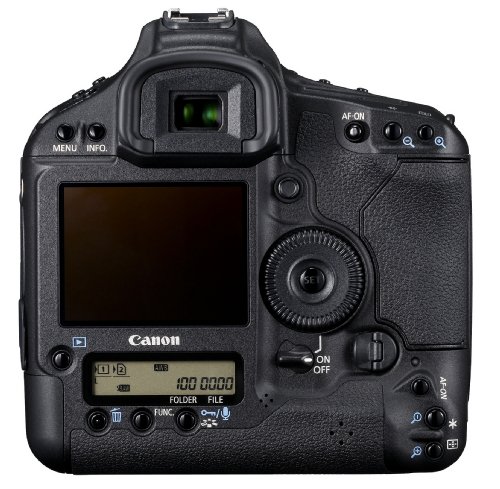
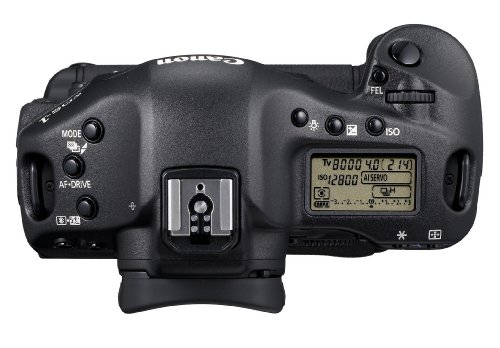
Offering a comprehensive combination of speed, accuracy and image quality, the EOS-1D Mark IV is the perfect choice for professional photographers and subjects on the move. With a completely redesigned 45-point AF system including 39 cross-type points, a new AI Servo II AF focus tracking system with improved algorithm combined with 10 fps continuous shooting, the EOS-1D Mark IV can handle even high-speed situations with ease. An APS-H sized 16.1 Megapixel CMOS Sensor, Dual DIGIC 4 Image Processors, a spectacular ISO range of 100 - 12800 (up to 102400 in H3 mode) with an advanced noise reduction system helps ensure sharp, low-noise images even in low-light situations. Add advanced Live View shooting, Full HD movie recording with selectable frame rates and manual exposure control plus a host of new features that enhance every facet of the shooting process. The EOS-1D Mark IV is the choice of professionals looking for the ultimate in SLR performance.
Readmore
Technical Details
- 16.1-megapixel APS-H CMOS sensor and Dual DIGIC 4 imaging processors- 45-point Area AF sensor including 39 cross-type AF points with f/2.8 support
- ISO 100-12,800 for shooting from bright to dim light with low noise levels
- EOS HD movie with manual exposure control and multiple frame rates; 3.0-inch Clear View II LCD monitor
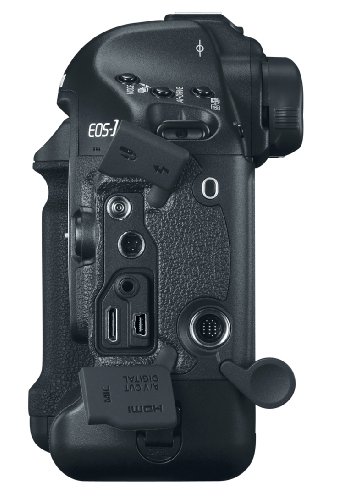
- Magnesium alloy body with shutter durability up to 300,000 cycles and exclusive dust-and-weather resistance
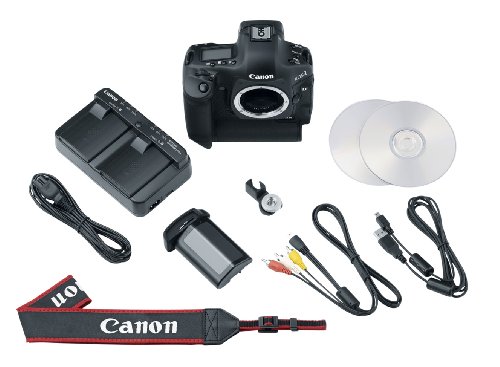
- Body only, lenses sold separately; capture images to CF Card Type I and II, SD/SDHC (not included)
See more technical details

By Me (Seattle, WA USA)
I've had the pleasure of using a pre-production 1D Mark IV for several weeks now, and I barely use my 5D Mark II anymore. As a photojournalist, this camera does everything I need it to -- most important for me:
- Low noise high ISO. I have no fear whatsoever going to ISO 12,800. Images are still sharp and have good color. No ugly lines at all. Perfect for shooting sports in stadium with crappy light (see link below).
- Better autofocus, especially in low light. With any camera I've used before, autofocus on low light was terrible. It's still not great, but it's a lot better.
- 10 FPS, with a large buffer. With a fast card (60 MB/s or higher), you can lay on the shutter for several seconds on highest quality before it starts to lag.
- Compared to the 5D Mark II, this thing is built like a beast. I've banged it around a lot and it still looks brand new.
Here are a couple galleries shot entirely with the Mark IV. I believe the ISO for the first one is 5,000 and the second is 4,000:
[...]
By Mark Kitaoka (Pacifica, CA United States)
I had the Mark IV on order with Amazon since Canon's product announcement on October 20th of 2009. Since my local camera shop received the unit on Monday January 4, 2010 and Amazon still listed it as "Not Yet Received" I purchased mine from the local retailer despite the additional $464 in sales tax.
I have been a Mark III shooter since June of 2007. For my professional work, my primary subject matter is live theatrical performance which includes acting as well as dancing ranging from ballet to traditional Tango to the very fast paced ballroom, specifically shooting Burn the Floor, which is just completing their Broadway run this month. Live performance shooting has many of the same elements of sports photography, except the lighting is much lower and at times more severe due to stage lighting. My Mark III performed well in most instances although I did have occasions where the autofocus did not perform as well as I had hoped. But to be fair, I cannot say with 100% certainty that it was the fault of the gear or the user, me.
For my non professional work I utilized the Mark III for extensive street shooting in the rain, high wind and many other adverse conditions. In all cases the camera performed well enough that I could only blame myself in those instances where I didn't get the shot. This includes night shooting of high movement subject matter.
I have never been concerned about the 10.1 MP size of the Mark III having had many of my images blown up to 6x8 feet posters used on the outside of theatres and large shots used in four color programs. I had several concerns with the Mark III which I had hoped would be addressed in its successor, the Mark IV:
1. A higher ISO range with equal or less noise
2. The ability for the focus point to switch when changing from landscape to portrait orientation. - Although the Custom Function allows one to change the rear wheel to adjust the focus point, I prefer to use that dial to adjust for exposure. Having to switch in a very fast paced situation caused me to miss some great shots.
3. More selection of focus points for manual focus point adjustment
Other than those three wishes, I was happy with my Mark III. In all three cases, the Mark IV met my wishes. I have done a comparison in low light, low contrast situations with both Marks at ISO 6400, which for the Mark III was considered H1. As such, adjusting the ISO from 3200 to 6400 was not possible in 1/3 stop increments. More on that later. In the comparison, the Mark IV handily beats the Mark III in terms of detail and noise at ISO 6400. Much more detail is visible which has something to do with a higher MP count, but at 100% crops, there is a marked difference. The noise on the Mark IV is less and of a different quality than the Mark III, more film like than digital.
During performances I had only used ISO 6400 in conditions which made lower settings impossible. I have always thought that a noisy shot is much better than one that is blurred beyond usage. My clients agree. One of my favorite lenses to use while shooting on stage as well as from the house is the EF 24-105mm f4.0 IS L. The focal range on a 1.3 crop sensor is just PERFECT, but the slowness of the f4.0 kept me from utilizing that lens with the Mark III unless lighting was sufficient. This will all change with the Mark IV as ISO 6400 is just fine using a f4.0 lens in my conditions.
Keep in mind that everyone needs to decide how a camera is to be used, under what conditions and it is naive to think that an investment in current glass won't influence a decision to stay or leave any brand of camera. I am heavily invested in Canon glass and all of them are L series lenses. I find that the color and sharpness of L series lenses are worth the investment, especially since I purchase most of them on the used market. There are folks who love to go back and forth on brand, pixel snooping, stats, etc. in hopes of proving themselves 'right.' I am NOT one of those people. To me a mediocre/poor/boring image is the same whether you take it with film, a full frame DSLR or medium format camera. (BTW, I'm not sure why 35mm is considered FF anyway. I consider 2.25x2.25 my idea of full frame!) My personal opinion is those who often argue ad naseum about camera stats take the lousy or boring pictures anyway.
I have NOT been able to use the camera in high movement, low light performance photography as I write this. My first opportunity for that comes this weekend. It will also be the first time I have the chance to shoot with two separate cameras with different lenses attached. That will give me a good, but not scientific comparison of the cameras, but more important for me is whether keeping both is worth the effort. I will decide if the Mark III gets a new home or not.
My advice is to base your hard earned purchasing dollars on what is right for your situation. My Mark III has performed well in the past and I'm confident after some of my own testing that the Mark IV is even better. Time will tell and as I gain more experience shooting with this new tool, I may add my insights here in the future. Best of luck with your own shooting!
UPDATE January 9 2010
Today I had my first opportunity to shoot in low light with the Mark IV. Although it was NOT as high movement/low light as I am accustomed, it was a very good initial test. I shot a choral group with musicians, so movement was nice and slow, except for the conductor. It was also the first time I was able to use two camera bodies without switching lenses. On the Mark III, I used a EF 70-200mm f2.8 L IS and on the Mark IV, I utilized the EF 24-105 f4.0 L IS. This focal range allowed me to cover all that was necessary. Obviously I used the f4.0 on the Mark IV because of its higher ISO range and noise performance.
I want to say that it will take some adjustments moving to the Mark IV. As I reviewed some images from other photographers using the Mark IV prior to receiving my own camera I had no idea what conditions the photographer's lighting conditions presented. I can say that because of the new sensor and ISO performance, it makes scenes appear MUCH more well lit than I experience with my human eye. In the past I have run -1/3 to -2/3 EV when using my Mark III to prevent blow out in highlights even using Highlight Tone Priority. Tonight I set both cameras on 0 EV to compare. The Mark IV presents a brighter image, about 1/3 stop brighter than the Mark III.
Because this was not a paid gig, I took more chances with the imagery than had it been for pay. I found that in camera Noise reduction of 1 Low suits my taste much better than -0 Standard in the Custom Settings function. There is a different quality to the noise produced at Standard over Low. I prefer Canon's Low setting, but your preference may differ. The highest I found it necessary to set the ISO tonight was at 10,000. Upon examining the images on my monitor, there is the most noise in the subtle shadow areas around the subject's chin and lower neck. This is normal in my experience along with noise in large solid color backgrounds. But the noise at 10,000 is easily much better than the Mark III at ISO 6400. In addition the detail that remains at 10,000 eclipses the detail, or lack of detail in the Mark III at 6400. I measure my detail in the hairline wrinkles around the eyes and in the forehead of my subjects. The Mark IV sustained those details where the Mark III at 2/3 stops lower ISO did not.
Also the noise produced by the Mark IV is more chroma than luminance. In my workflow, chroma noise is MUCH easier to reduce than luminance noise. The dynamic range of the Mark IV in terms of color is FAR superior to the Mark III, but I attribute this to a new sensor and new processors. Camera bodies are really just like computers, as soon as they come out they immediately begin to become obsolete. The color and white balance are MUCH better than my Mark III. It still takes some adjustment, but much less than the III.
The automatic focus point association between landscape and portrait is a God send! Also the Mark IV takes advantage of UDMA card speed. I purchased a 32gb Sandisk Extreme CF card for the Mark IV and it's rated at 60mb per second. In shooting RAW burst, the ability of the Mark IV to write to the card after the buffer is full is easily three times as fast as the Mark III, but to be fair the III doesn't have UDMA capability.
So far so good. I plan to keep my Mark III simply because shooting with two cameras with different focal length lenses is the only way to go for my work. At some point I will replace the Mark III with another IV, but that will take time and a few more clients. It will be interesting to see how the images look at high ISO in large format, which much of my work is used as with clients. I'm happy with my choice so far and anticipate that more work in my normal venues will continue to show favorable results.
My issue is now how to build up my neck to support two 1D bodies with a 70-200 on one and a 24-105 on the other! When I use my 28-70 in place of the 24-105 it's going to be a real pain!
FINAL UPDATE: January 17 2010
Tonight I had my first opportunity to shoot a theatrical performance with the IV. I can only say that Auto ISO along with AI Servo will change how I shoot theatre. The settings I used tonight were Highlight Priority On, AI Servo, single shot, Auto ISO, ISO range L to 12800. The lenses I used tonight were the EF 24-105 f4 L IS and the EF 70-200 f2.8 L IS. Anticipation is such a major part of theatrical shooting, waiting for just the right expression, gesture and moment. I was able to capture images tonight with a clarity that I have not experienced with my Mark III. Auto ISO constrained within the parameters I wanted left me free to concentrate entirely on capturing the moment while retaining a speed proportionate to the focal length. By freeing me up from keeping an eye on the shutter speed, which was set by the Auto ISO, I was able to compose my shots more accurately. Using AI Servo for my focusing also allowed me to follow the subject and keep them in focus just before pressing the shutter. I watched and anticipated their expressions like never before.
The ISO varied between a low of 800 in very good stage lighting to a high of 12800 in those scenes where it was too dark for me to know the actor's expression. I ran an EV value between -.33 to -1.0 to compensate for harsh spot lighting, so common in stage work. In those cases where the shot was very dark, where the actor's face was shaded in a very dark manner, ISO 12800's noise is very visible, but not to the point where a noise processor will bring the image back to usefulness. In those cases where light is medium, I will NOT have to use noise reduction post processing for printed images in large format.
So with my last entry I will simply say that I am pleased to have made an investment in the new Mark IV. It surpasses my Mark III in a way that will now allow me to press the limits of my ability to capture even more compelling imagery. And in my work, an image that moves the viewer is one I'm proud to produce, regardless of the equipment. The Mark IV will certainly push my own skill limits in a way I'm happy to undertake. It's a tool that will help expand the level of my own creative process.
Best of luck to all of you in whatever you decide to purchase and shoot. It's time for me to get back to work.
By William D. Colburn (Socorro, NM USA)
(Edited to fix my poor grammar and reword a few things to be more clear)
The 1D mk III was my first 1-series body. Before that I had, in reverse order, a 5D, a 20D, and 300D. Each step along the way was nicer and nicer. I couldn't imagine a better camera than my 1D mk III, but now I have it.
Over time (mostly through reading about the camera) I learned that my mk III had poor autofocus. I had an early version with the defect, but also because the mk III apparently did not live up to the autofocus of the 1D mk IIn. I had the defect fixed, and my auto focus was better, but still not as good, or so I had read, as the mk IIn autofocus. I can attest that I certainly felt frustrated with the mk III autofocus on a regular basis.
I haven't been to a sporting event yet, so I can't speak to that kind of focusing, but in good light with a stationary subject my gut feeling is that, yes, focusing is better in the mk IV than it was in the mk III. I can also attest that in near darkness conditions, such as when I can't even see my subject (and a 1.2 lens), the autofocus is astounding. Astounding there is relative; in this case I mean it often acquires focus, which is quite a feat in near total darkness.
This camera is 16MP instead of 10MP, but so far I haven't noticed much of a different in quality from the smaller photosites. Canon said the microlenses were an improvement, and I'm quite willing to believe them.
My ReallyRightStuff L-bracket from my mk III fits perfectly, which is a nice bonus. It uses the same batteries as my mk III was well. The mk IV doesn't come with a wall adapter like the mk III did, but I have a mk III so it wasn't a terrible loss for me.
The battery life is supposedly down with the larger sensor. Canon claims something like 1200 shots I think, while the mk III supposedly got 1900. I know I usually got 7000 per battery if I drained a battery over a few months, or about 12000 if I shot a major event in a single day. While the battery performance still seems good (I didn't start with a fresh battery, and I've been out in the cold a lot with it), it is definitely not as long-lived as in a mk III body. The battery smart-logic only understand shutters, and doesn't keep track of video, so shooting movies will play havok with matching up a shot count to the battery life.
The aesthetics of the menu system are much improved. It is basically the same menus as the mk III, but they feel more polished now.
The high iso is, well, high. I won't lie to you: at H3 you get something barely above garbage out of the camera; but you get something! It's absolutely astounding to be able to shoot in that much darkness. H2 is pretty bad, and H1 is kind of all-right. And I haven't found anything that needed any of the H modes; 12800 has been more than adequate for playing around in. I'm quite happy with the exended ISO, and noise at that level is something I expect. The camera can be pushed further with H3 than I even pushed B&W film, and the results are quite good for the circumstances.
When you stick to ISO 12800 or lower the results are quite spectacular. My gut feeling was that 12800 is about as good as 3200 on the 1D mk III, but I hadn't specifically compared them to see. I've uploaded a comparison picture to Amazon showing two shots that compare the ISO. The mk IV 12800 definitely seems to be better than the mk III H1 (6400).
I like the new rotation-selectable AF points. I like the new corner brightening options.
The video I've barely played with. Auto focus in video sucks, so you need to manual focus. The lack of a level control on audio-in is a serious deficiency. The video does look good though. I've barely played with it though, and I've never owned a video camera (I've only owned a film-based movie camera), so I'm not sure what I can say about it. I do know that it takes a long time to upload a minute of Full HD to YouTube.
I guess that is all I can think of at the moment.
I like my new camera.
Images Product

Buy Canon EOS 1D Mark IV 16.1 MP CMOS Digital SLR Camera with 3-Inch LCD and 1080p HD Video (Body Only) Now

No comments:
Post a Comment